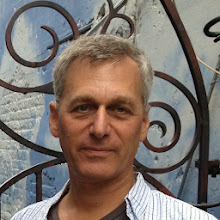
Sam asked, "How long did it take to make this book?" Answer: "Over a year." Weve been back over a year. The book is now out. It had a press run of one, so if you want to see it in the flesh, you have to come over. Or you can see the online version here:
Monday, August 29, 2011


Sunday, July 18, 2010
Act 2 -- The Curtain Rises
Five months and 10 days. A good run. A good rest. A good adventure. A good period of self reflection. Making friends. Trying new food. Spending time with Susan. Traveling.
And it comes to an end tomorrow. I go back to work.
I'd gotten so used to NOT going to work. When we were traveling, sometimes Susan and I would look at each other and proclaim, "What have we done?", or "Are we really doing this?" We'd meet people and explain what were were doing, and be met with a look of puzzlement. What we were doing was not "normal", but as far as we were concerned, it should be. If you have a chance to take a break somewhere mid career, go for it.
I am ready to go back. Have a mission that is not just about "me". There were times I felt guilty about being so self-absorbed, but then I knew it was only temporary. It was important to spend time on "me".
I take away from the adventure that there's a balance between taking care of my own needs, and contributing to my community. Whether that community is my family, my neighborhood, my profession or my world. Moving forward, I hope to keep the world in balance. Between my workaday life, and other interests.
Just Give Me a Project
I'm 52. "Normal" retirement age is 13 years from now. Or maybe 15, depending on how you calculate it. And it's not abnormal for people to live into their 70s, 80s and beyond. That's a lot of years. If at some point I stop working in the normal sense of the world, what will I do?
What will I do? It's a question that will be faced in droves by my generation. The boomers. And as I've talked to people around my age, I hear the questions being asked.
So, give me a project. Or, more specifically, I'll be finding projects that I want to do. Some will be at work. After all, I'm an urban planning consultant, and I get paid to manage projects. But there are other projects needing doing. Long before I retire. So that when the time comes to retire, I'll still be active, and more importantly, relevant.
I'll be exploring new frontiers in food. New frontiers that are really old, but somehow over the last few generations have been lost. We're in the best of times and the worst of times. The best in that there is so much cheap food available that we no longer have to worry about getting enough calories just to survive. The worst in that there are so many cheap calories around that we've developed diets and lifestyles that make us ill. That's a simplistic summary of a complicated problem, and if you're interested, please check out books by Michael Pollan and Mark Bittman who have written extensively and eloquently on the subject.
Anyway, I'm a pretty practical guy, so I hope to search out new foods, try or invent new recipes, and tell the story through photos, video, and writing on my food blog, Improbable Pantry. I've been writing there (and my previous blog, Chowplay, for a couple of years, but I hope to be a little more focused, and see if I can actually get a few people beyond my friends to read it. Stay tuned!
 So, as I sit here on this warm (finally pleasant) summer evening on the back patio, protected from the mosquitoes by the tiki lamps and mosquito coils that actually seem to be working today, I look forward to the next act. And remember those days when I was THIS laid back...
And it comes to an end tomorrow. I go back to work.
I'd gotten so used to NOT going to work. When we were traveling, sometimes Susan and I would look at each other and proclaim, "What have we done?", or "Are we really doing this?" We'd meet people and explain what were were doing, and be met with a look of puzzlement. What we were doing was not "normal", but as far as we were concerned, it should be. If you have a chance to take a break somewhere mid career, go for it.
I am ready to go back. Have a mission that is not just about "me". There were times I felt guilty about being so self-absorbed, but then I knew it was only temporary. It was important to spend time on "me".
I take away from the adventure that there's a balance between taking care of my own needs, and contributing to my community. Whether that community is my family, my neighborhood, my profession or my world. Moving forward, I hope to keep the world in balance. Between my workaday life, and other interests.
Just Give Me a Project
I'm 52. "Normal" retirement age is 13 years from now. Or maybe 15, depending on how you calculate it. And it's not abnormal for people to live into their 70s, 80s and beyond. That's a lot of years. If at some point I stop working in the normal sense of the world, what will I do?
What will I do? It's a question that will be faced in droves by my generation. The boomers. And as I've talked to people around my age, I hear the questions being asked.
So, give me a project. Or, more specifically, I'll be finding projects that I want to do. Some will be at work. After all, I'm an urban planning consultant, and I get paid to manage projects. But there are other projects needing doing. Long before I retire. So that when the time comes to retire, I'll still be active, and more importantly, relevant.
I'll be exploring new frontiers in food. New frontiers that are really old, but somehow over the last few generations have been lost. We're in the best of times and the worst of times. The best in that there is so much cheap food available that we no longer have to worry about getting enough calories just to survive. The worst in that there are so many cheap calories around that we've developed diets and lifestyles that make us ill. That's a simplistic summary of a complicated problem, and if you're interested, please check out books by Michael Pollan and Mark Bittman who have written extensively and eloquently on the subject.
Anyway, I'm a pretty practical guy, so I hope to search out new foods, try or invent new recipes, and tell the story through photos, video, and writing on my food blog, Improbable Pantry. I've been writing there (and my previous blog, Chowplay, for a couple of years, but I hope to be a little more focused, and see if I can actually get a few people beyond my friends to read it. Stay tuned!
 So, as I sit here on this warm (finally pleasant) summer evening on the back patio, protected from the mosquitoes by the tiki lamps and mosquito coils that actually seem to be working today, I look forward to the next act. And remember those days when I was THIS laid back...
Wednesday, July 14, 2010
Winding down, winding up. But then there's the food!
This five month break is winding down. I go back to work in five days. Five days! Less than a week. I could get philosophical about this. And maybe I will. But not now.
Right now, I just want to enjoy the memories. And transition.
Intermission is ending, but I'm gearing up some other exciting activities on my other blog, Improbable Pantry, about cooking and eating. So, migrate over to that site, and see what's cooking.
It seemed only fitting, then, to do a little tribute to the food of our trip, mostly in Europe, but some in North America and the Caribbean. Just a bit of fun. Enjoy!
Right now, I just want to enjoy the memories. And transition.
Intermission is ending, but I'm gearing up some other exciting activities on my other blog, Improbable Pantry, about cooking and eating. So, migrate over to that site, and see what's cooking.
It seemed only fitting, then, to do a little tribute to the food of our trip, mostly in Europe, but some in North America and the Caribbean. Just a bit of fun. Enjoy!
Saturday, June 12, 2010
Boston, as Visitor
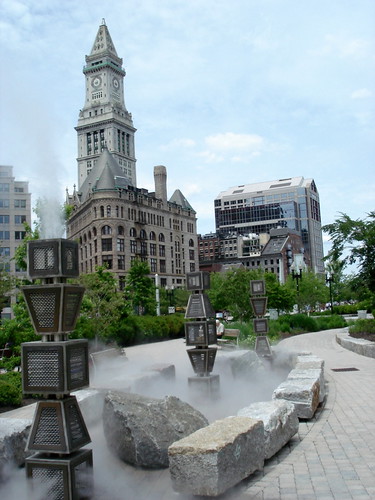 We've been back for two weeks now, and it finally occurred to us to be tourists in our own town. Our traveling instincts said to take the day to get the feel of the place before we figured out what to do. But hey, we know Boston, and we were up for a walk, so we decided to check out the new(ish) Rose Kennedy Greenway. I had watched it be built from occasional meetings at the top of One Financial Center, and had seen pieces of it completed,
 Bottom line -- a decent start, but still a long ways to go. There were stretches that were wide open without a whole lot to recommend them. This section here was filled in some more with attractive landscaping, and a cool (pun intended) misting fountain.
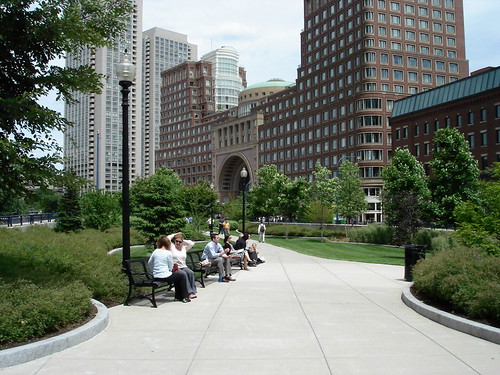 Further south, we enjoyed the plantings, and there were some people strolling, but really, the activity level was moderate, but certainly not buzzing. Certainly not buzzing like some of the public spaces we saw in Europe.
 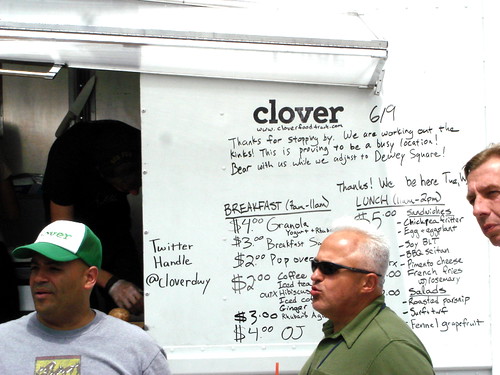 We had just finished saying that what the Greenway needed was some food vendors, when we came upon this sight of a single food truck, called Clover, selling mostly vegetarian fare. The food coming out looked good and healthy, reasonably sized, and the menu items were inexpensive -- about five bucks for a sandwich.. The Rhubarb Agua Fresca we tried was excellent -- not too sweet, though the iced coffee was a little bitter. We discovered that this was only their third day at the Dewey Square location. And then, when we picked up the Boston Globe the next day, we were encouraged to see this article about how there soon will be many more vendors in the square. Here's hoping that the food attracts and keeps more people to the Greenway.
Check out a few more pictures of our stroll on Flickr.
Thursday, May 27, 2010
So long, farewell, auf viedersehn, adieu
View Intermission in a larger map
Tonight's our last night on this European journey and we're winding down. We drive Brussels-Frankfurt tomorrow, and fly home in the evening.
We visited a lot of places. Spoke a few languages. Ate good food. Met good people. Saw this part of the world from different perspectives. Learned how much we didn't know, how much we take for granted, how things are not always as they seem. And how to find toilets in unfamiliar places.
Eleven+ weeks on the European portion of the journey. More than 14 weeks if you count the western hemisphere piece. We'll miss this vagabond life, but are happy to be heading home. And Susan and I still talk to each other!
I hope to do some more processing over the next few weeks -- of pictures, thoughts, reactions, comparisons. So this blog will continue.
Outdoor culture in The Netherlands
We tend to think of outdoor cafes in Paris, but we've found them all over in our travels. But none have been as ubiquitous and energetic as those we found in The Netherlands. In Amsterdam, there are whole streets taken over by outdoor dining, with one restaurant's seating flowing into the next. And the large squares are often filled with seating. These scenes repeat every few blocks. Leave one buzzing plaza, walk a couple of blocks, and come upon another, also buzzing. This is true in tourist areas and neighborhoods. Moving on to The Hague and Delft, we found this as well.
It finally occurred to me that taking a simple photo would not convey the energy, so I opted for the video approach to capture the bee-hive. This one was in Delft, on a public holiday when all the stores were closed. But you can still feel it. It is on the sight of the old cow market. I suspect the buzz was a little different then.
And they all served Belgian beer!
Tuesday, May 25, 2010
I'm falling for the blonds
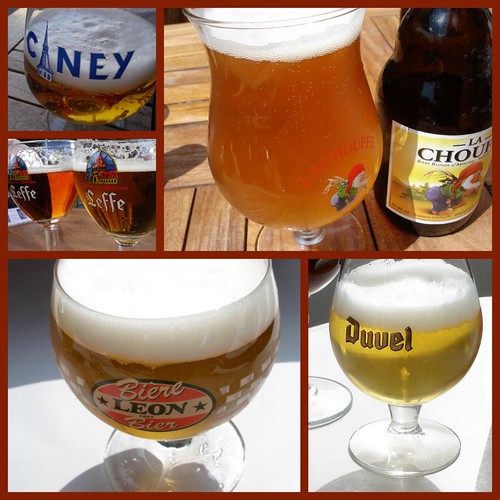
I challenge anyone to be in Belgium, the Netherlands and Germany without falling in love with the beer. As with wine and cheeses, I find that I can't remember the names of the ones I like from sitting to sitting. In Provence, I got accustomed to ordering the Cotes du Rhone or Cotes du Luberon wines, but couldn't tell you from which vineyard or town. The cheeses in the markets were so numerous and I wanted to try so many that I couldn't remember the ones I liked.
Belgian beer is world famous. And I'm finding out why. Beer accompanies lunch, late afternoon apertif, and dinner. In my world of beer there has been lights and darks. And perhaps I'd order a Pilsner or Lager on occasion if I wanted to seem like I knew what I was doing.
One day, Susan ordered a Duvel beer. A blond Belgian beer. I had ordered something else -- perhaps something dark, I really don't remember. When I tasted her Duvel, I was in love. It was smooth. Not bitter. A deep rich taste. Gorgeous color. Great curves. (In Belgium, the Netherlands and Germany each beer is served in its own distinctive glass). Next time, it was me that ordered the Duvel. And since then I've tried the blonds on the menu. Each has been great. Each with its own taste, but as a family, these Belgian blonds have captured my heart.
Susan thinks we can find Duvel back home. I hope so!
Wednesday, May 12, 2010
Movin on....
No more pastis on the porch. No more self-cooked dinners. On the road again. Susan had a poetic farewell to Ansouis on her blog, and it's hard to improve on the sentiments, so I won't try.
We spent a few days in Arles, at the apex of the Rhone River delta, gateway to the Camargue. Arles is a fine small city, filled with Roman antiquities and medieval streets. It was also full of photographers, as it often is. It is home to France's National School of Photography, and there happened to be the annual exhibition of nudes in six or seven venues. It was great wandering around so many photographers and people that appreciate photography. The other photo part of the trip was a visit to the Cathedral d'Images in Les Baux de Provence, a slide show/movie presentation inside an abandoned bauxite mine, with images projected onto the walls in the 12 meter high rooms.
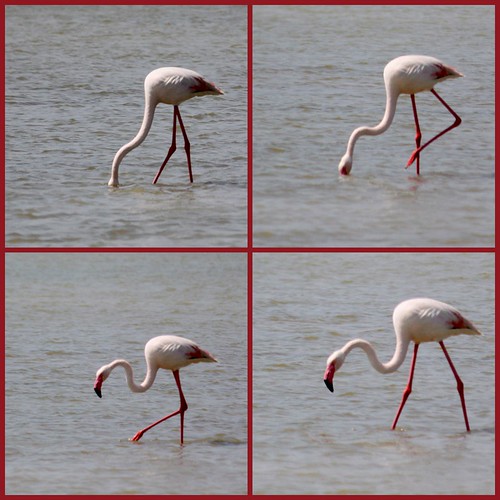
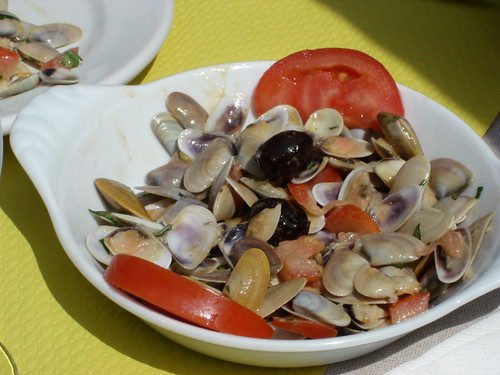 We timed our visit to the Camargue to match the one sunny day, and had a delightful driving, strolling time investigating the sights and the birds. The flamingos were a special treat. A great meal, too, at a small auberge far from anywhere, with the small local clams their specialty.
In the meantime, we've made our way east, with a quick stop in the maritime village of Antibes (between Cannes and Nice), with it's yachts of the wealthy and the Picasso museum, finding our way to the top of the hill in Castelvittorio, where Susan's sister and sister in law live. We thought we'd had our fill of medieval villages, but the Italian version were so much different than the French that we were once again spellbound...stay tuned for some pics of the villages and of the terraced rural living that has to be seen to be believed.
Presently in the Nice airport awaiting a quick flight to Dusseldorf to see Susan's brother and family, and then the northern European portion of the journey.
Tuesday, May 4, 2010
Jumbo artichokes and jumbo mountains
Five weeks has gone by quickly. It's Tuesday, and we depart Ansouis on Thursday. Which means we've had to be judicious when visiting the markets, casting aside all sorts of culinary temptations. Last night was "everything that needs to be eaten jumble". Which tasted pretty good, but still, you can feel the constraint and the underlying message that we'll be leaving here soon.
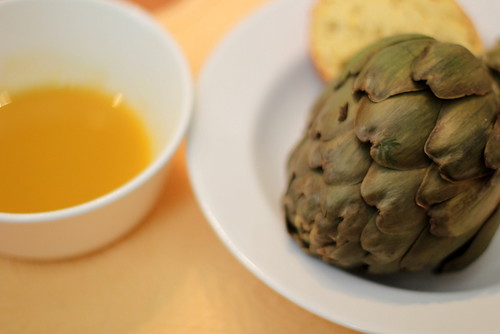
It was pouring rain and chilly this morning, which meant that the Cucuron market wasn't hitting on all cylinders. Only a few stalls, and not many people. The rotisserie chicken and potatoes cooked in chicken fat seemed like a good easy choice. And there were a few ginormous artichokes. I'd stayed away from artichokes since the disappointment with the little purple ones early in our stay here, but I'd been wanting to try these artichokes that were the size of grapefruits.
Simple steaming (for only a half hour -- I was surprised how fast they cooked). Simple mustard vinaigrette for dip, and we had lunch. There were some tough outside leaves, but the artichoke was as it should be, and the hear was huge. Part of the stem was edible as well.
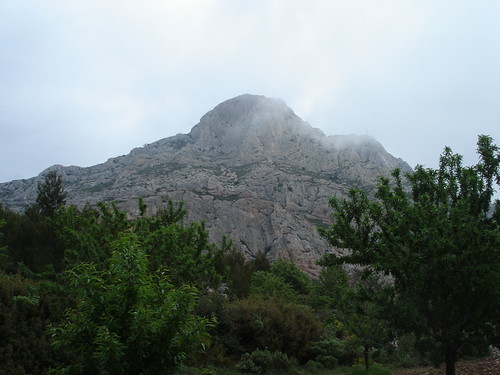 The highlight of the week was the climb of Mont Saint Victoire, the mountain that Cezanne was fascinated with. Upon our arrival in Provence five weeks ago, it was an imposing presence as we departed the TGV station in our rental car. We'd been wanting to climb it, and finally did so when B&A invited us along on one of their hiking journeys.
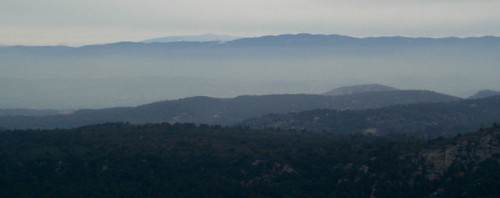
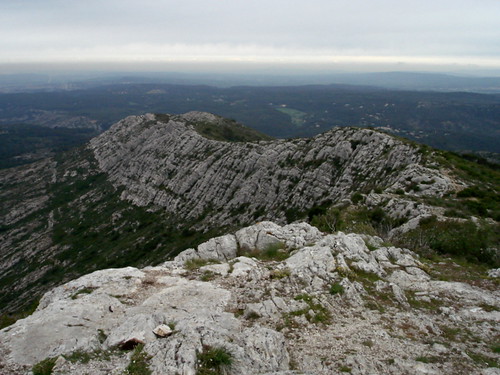 It's even more imposing up close. From this view, it looks like any other mountain (albeit one that's pretty bare), but from the south, you can see that the mountain top stretches for kilometers behind that pointy summit. The photo is taken near the start of our climb. It was a hardy two hour climb, with fantastic views throughout. I loved the view down the west spine, showing the flowing geology of the mountain. And we had great views of Mont Ventoux off the north side. And lest the food theme that began this post be lost, our simple picnic lunches were made even more splendid by the frequent wishes of "bon appetit!" from the other hikers at the chapel near the summit. Everyone that passed us, without fail, expressed this joyous greeting.
Pics from the day!
Sunday, May 2, 2010
Of Churches and Lunch
 France has lots of churches. Like the rest of Europe. And a lot of them are old. Really old. And in places that may have once been bustling, but are now on the top of lonely hilltops. Or desolate forest glades. Some of these are ruins. Some are kept alive. Presumably by the Church (with a capital C). But it might be the government. Not sure. For old times sake?
 The thing is, though, that no one seems to actually GO to church. They barely go to the churches in the lively cities, much less the ones in neglected ruin-towns. We were here on Good Friday, but no one took off, and it seemed like every other day. Ditto Easter, though we did hear some bells ring. The signs on the doors of the various churches around here say that Sunday morning services rotate among the three or four village churches from Sunday to Sunday. But all of these are good sized churches that are being kept going. In the US, The Church is closing churches for this reason. That doesn't seem to be going on here. Supply and demand doesn't seem to make a difference.
In Italy, at least, we saw people praying in the churches. Among the tourists, there's always be someone taking a few moments for themselves. Not here. Strictly tourist attractions as far as I can tell.
This morning (Sunday morning), we went to the grandaddy of all the outdoor markets in Provence at Isle sur la Sorgue. Blocks and blocks of produce, clothing, nic nacs, soap, lavender, sausages, and the thing that makes this one special -- antiques. It was pouring rain when we left the house at 10:00, but cleared by the time we got there at 11:00. Spent a good hour wandering the stalls, thankful that we have no room in our luggage for anything of substance. (That's me talking -- I'm not sure if Susan is thankful or not). The place was thronged. I can only imagine how busy it would be if it hadn't been pouring rain just an hour before. Or in the height of tourist season.
Roundabouts 12:00 we started to feel a little hungry, so scouted out some lunch opportunities. Which were plentiful. Plentiful. But they had to be. Because Sunday lunch in Isle sur la Sorgue, as in any other bustling place in the south of France, is like a game of musical chairs. You can't wait too long, or you won't have a place to sit. Because everyone eats at the same time. At noon, you can have a table, but some have already been reserved. By 12:30, the pickings are slim, and you might be eating off the pizza truck. Since lunch is a two+ hour affair, there are no second chances. (Though, at the place we ended up, there did seem to be a small throng of people looking hungrily in our direction. I didn't think anything of it until I realized they were waiting for our tables!. Which I hadn't seen for so long I didn't know what to make of it.) We settled in at about 12:15, just in time to snag an outdoor seat, under an umbrella, that wasn't behind a market vendor's truck or on an awkward tilt. Perfect.
Lunch was good. Very good. Three-course "menu" for 15 euros. (The last time I was in France, there were Prix Fixe menus everywhere -- I haven't seen that phrase at all this time.) Mussels gratinee to start, duck-leg confit for the main dish and isle flottant for dessert (floating islands of meringue in a vanilla flavored sauce). With a shared 0.5 liter picher of rose. No one was in a rush. Not us. Not the kitchen. The waiter seemed a little flustered, but I'm not sure why, because the attitude of the French waiters seems to be "you'll get your food when you get your food", and "I'll take your order when I'm good and ready -- you're going to be here for a few hours anyway, what's your rush?" And unless we're starving, we're generally fine with that. The other night, we waited a half hour for our menu. We think it was punishment for not ordering apertifs.
It would be nice if they thought to bring the little basket of baguette out when you sat down, rather than waiting for the first course. Take the edge off a little? No one seems to have thought of that. Maybe it's illegal. Did you know that the government fixes the price of baguettes?
By the time we'd finished our first course, we noticed that the streets had emptied. EVERYONE was eating lunch. Shopping's done. Lunch begins. This happens regularly here, even on weekdays. Businesses close at least from 12-2. Some from 12-3, and the grocery store from 12-4. Plan accordingly. Do not get between the French and their lunch. Interestingly, though, more and more stores are open "non-stop". We noticed many such signs in Aix en Provence. And the Hyper-U is open non-stop. I wonder what those negotiations with their labor force looked like? I'll enjoy the convenience of non-stop shopping, but if the idea catches on, something larger will be lost.
No one's in church on Sunday, but everyone's eating lunch. I can't complain with that set of priorities. There was a lot of family together-time. And friends enjoying each other's company. Good wholesome activities. Maybe if they served lunch at church?
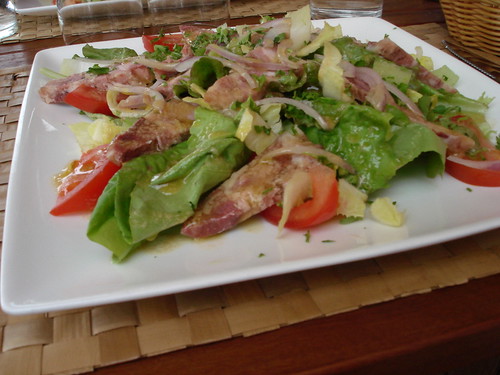
That lunch you see at the top? Not today's -- I didn't take a single picture today. But it was yesterday's lunch, so it fits the topic. Beef brain salad. It was worth trying. And inexpensive. Like any cold cut really. Susan's choice was much better -- shrimp sprinkled with grapefruit juice and cilantro. That was worth reverse-engineering.
Thursday, April 29, 2010
Vibes of History
When traveling about Europe, you can't help but be entranced with the remnants of the past that are everywhere. In the US, we have the occasional historical site, some less than 100 years old. Here, especially in the tourist areas, but really everywhere, everything has a long history. In Ansouis, the village where we're staying, there is a Chateau at the top of the hill that was built a thousand years ago. And ownership had been in the same family until just a couple of years ago. I sometimes wonder when I see villagers and farmers how long their families have lived in this region.
There are also ruins everywhere. Some from the Roman ages, some from medieval times. The Roman ruins are stunning, but they're generally bits and pieces lying around, that don't give a sense of what life must have been like. Some of the medieval ruins are well preserved. For example, the village of Oppede le Vieux is a place I'd seen last time I was here, and was eager to show Susan. The main attraction was the old village topped as usual by a chateau. Although this chateau was in ruins, there was enough left to give some feeling of the time. It had been a stronghold of a local ruler who had made it his business to seek out and destroy the Vaudois, the renegade Christians that were trying alternative approaches the the Pope's church. Oppede le Vieux is perched on a hill on the north side of the Luberon with a commanding view of the valley below. On the day we were there, it was crystal clear, and we could see Mont Ventoux.
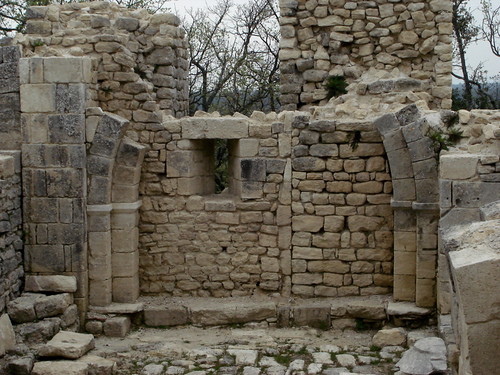
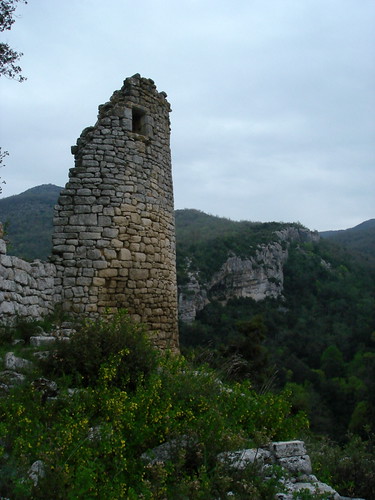 But this was one chateau in one medieval village. Then we visited Fort Buoux. Pronounced beyu-ouks we are told. Near the village of Buoux, a village of a little more than 100 people, this fort is on a promenade overlooking the Vallon de l’Aiguebrun, it has been inhabited for millenia, and there are archeological remnants dating back that far. What you see most obviously is the 13th century fort that was ordered dismantled in the 17th century by Louis IV. It had also been a place of refuge for the Hugenots (same as the Vadois? I'm not sure). There are several ramparts, guard towers, storage bins for grain and water, dwellings, and a Romanesque church. Plus a secret staircase down the back. The vantage point makes this place impregnable. An assortment of pictures on my Flickr page.
These were not the dwellings of the privileged that we see most places in chateaus, castles, schloss, pallazo. These were people struggling to get by in homes no more ornate than caves, protected by several layers of trenches and walls, up on a hilltop promenade. Though clearly impregnable to attack, it seemed to us very vulnerable to siege. Where would the food come from if surrounded? The sheer cliffs nearby must have provided hiding spots for defenders of this fort. (Apparently, this is a favorite spot for rock climbers, too).
The fort is the property of the commune of Buoux. The caretaker lives on site and sells tickets in exchange for your 3 euros. While visiting "up top", we were surprised by his head popping up from under a cliff -- apparently free-climbing up the wall. He said he goes that way when he's in a hurry. We chatted with his wife (well, we assumed it was his wife) for a bit, and found that they've lived there for 40 year. Their home is graced by spectacular gardens, which they must have time to tend between groups of travelers. Sneaking a peek inside, we were surprised to see a substantial pile of books on the table -- not your average ticket taker!
Monday, April 26, 2010
The Swifts -- Our Feathered Neighbors
We sit on the deck here a lot. A lot. To eat. To sun. To read. To knit. To chat. To check e-mail. Especially now that it's warmer, if we're at the house, we're up on the deck.
To keep us company, are the Swifts. They're a pack, swarm, family of small birds that cannot be ignored. One moment their floating on air currents, high above, subtly tipping their wings one way or another to steer. Next, they're swooping and diving, wings aflapping, making banked turns just over our heads. They get close enough we can hear their wings whoosh by, and when they're flapping, we can hear the flaps.
They fly independently, but often dance with their buddies, in twos, threes, fives, sixes. At any one time, we might see fifty or more, but sometimes there's only one or two. They tend to be out at our mealtimes (and theirs!), especially dinner, when the bug population must be highest.
We learned from JAdR that they spend virtually their entire lives in the air. The only time they come down is to nest. 80% of their lives in the air. These are not your average bird. Through some other internet sources, I've learned that they can (and often do) outrun thunder storms, flying hundreds of miles to avoid being rained on. They sleep "on the wing", up in the air currents. They were once thought to not have feet at all, but it turns out that they just have small feet. Why have feet if you're up in the air all the time?
We've come to enjoy the company of our friends, the Swifts.
As a side benefit to the Swift experience, I've discovered a whole new side of my cameras, that is the video piece. Now, I may be the last person on earth that's discovered this, but the video quality of these cameras is pretty swift. Susan and I also discovered a new use for the video. When we're out an about, and we want to remember something, and it's not something we can take a picture of, we can just record the other person saying it out loud. In a video file. Most people use the video for more creative things, but hey...use what you got.
Friday, April 23, 2010
Gnovel Gnocchi

The markets here abound with surprises. In Pertuis last Friday, Susan found some basil gnocchi, and she's a sucker for gnocchi any time. I'm generally less excited about gnocchi, rarely finding the potato-based pasta to be anything other than a gooey disaapointment. Susan made half the gnocchi last Friday for lunch, right after we got home. She enjoyed it, but wasn't overwhelmed. I demurred, figuring why bother.
The second half remained in the fridge, in the ubiquitous small paper bags that they give here at the markets that ensure that you can't see what you have on hand.
In the meantime, I saw a post somewhere about an alternative approach to gnocchi -- pan frying instead of boiling -- that really got my attention. Now, I'm a sucker for crisp, browned potatoes of any sort. Roasted potatoes, home fries with onions, whatever, and I'm a fan.
We had scored some asparagus from the honey lady at the Cucuron market on Tuesday.The thick bundle became part of lunch on Wednesday to accompany a charcoal-grilled chicken (first BBQ of the season!), but still had a bundle of the thin ones. The honey lady said the thick ones were best for stand-alone use, while the thin ones were good in things like omelets. Omelets, gnocchi...hmmm.
(By the way, I'm having a great time typing the word gnocchi. Gnocchi, gnocchi, gnocchi. Susan's even teaching me how to pronounce it properly -- think the transition between syllables of "banyan" or "canyon" to handle that awkward "gno" start.)
So. Couple of glugs of olive oil in the skillet. Couple of cloves of garlic minced, sauteed for a minute or so to flavor the oil. Add in the asparagus, sliced into three or four pieces each, on a bias. Add in the gnocchi at the same time. Cook on low for a few minutes to get them both cooked through, then crank up the heat to brown. A little salt and pepper before serving, and we're done.
I was in heaven. I'll eat gnocchi like this any time. with any kind of accompaniment. The texture was firm, but not mushy. The slight crunchiness added some interest. Like eating potatoes! Susan was disappointed that the basil-flavoring of the gnocchi (it was basil gnocchi) wasn't coming through, but I didn't care. I have a feeling that sitting for almost a week in the fridge didn't do it any good on that score. The garlic/oil was enough for me. And the asparagus cooked this way was perfect as well.
Bring on the gnocchi I say. As long as I can use my skillet. Gnocchi, gnocchi, gnocchi, gnocchi.
Wednesday, April 21, 2010
To market, to market....
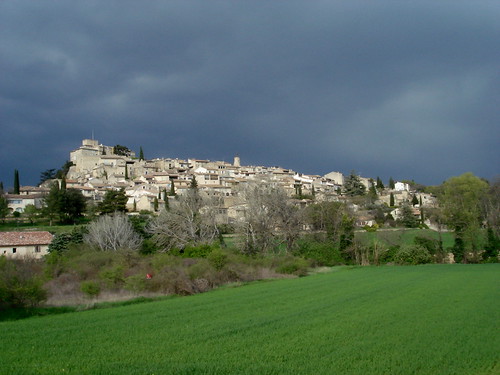
Well, the weather's turned from being cold at night and first thing in the morning, with a chance for cloudy/rainy/cold during the day or bright blue skies and crispy, maybe creeping up to 60 or 65 if we're lucky, to warm evenings and mornings, and stellar middays. Today was supposed to reach the mid-70s, and I'm pretty sure it did. But, dramatic stormy skies are way more interesting in photos, so that's the lead photo in this post, despite the title.
We spend a lot of time thinking about food and how/where to get it. Each town has market on a different day. Our little town of Ansouis has a small Sunday market, with one vegetable vendor, one charcuterie/ (salami, etc)/cheese vendor, one chicken/rabbit guy, and some jewelery.
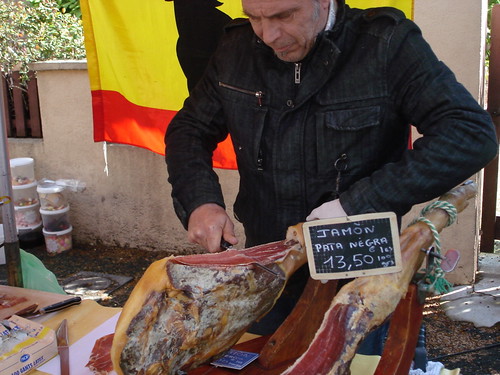 The next small town over, Cucuron, is on Tuesday, with a larger market, boasting several vegetable vendors, honey/asparagus, cheese, salami, olives/tapenade and various dips, prepared foods, and clothes. And, a couple of bar/cafes to rest after the effort of making decisions about what to buy.
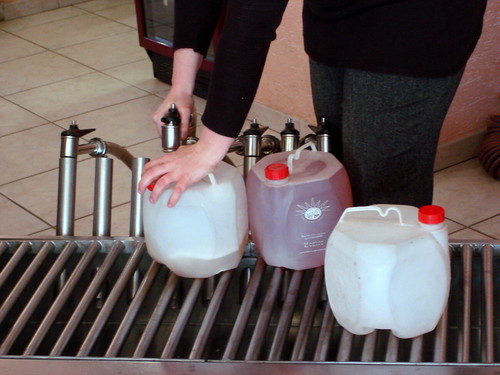 You can also fill up your own bottles with your favorite wine at the wine filling station.
The little city nearby is Pertuis, and it's on Friday morning. It's big. Blocks long. Anything and everything. Lots of clothes and nick naks. The paella I raved about the other day. Competing with Pertuis on Friday is Lourmarin -- a small, chic town also with a large market, higher end stuff, and higher end prices.
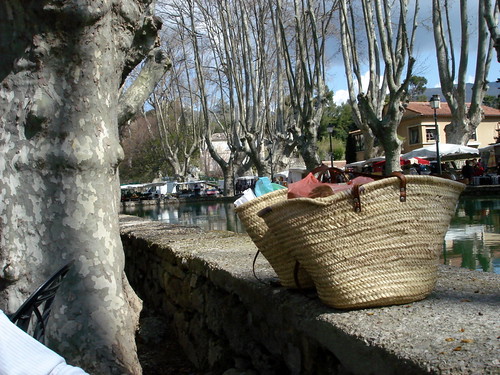 Without a car, we've been fortunate to have friends offer to take us one place or another, but the market event can consume half the day. Then, there's the Hyper-U. Pronounced Eeeeper ooo. I refused to say this for a while, when it's clearly the hiyper you, or as some of the expats we've met call it, the hyper-tension. Think Walmart. Always busy. But they actually have some pretty good stuff, and I'm sure they've given the little markets a run for their money. They rent cars too. And cut hair. Develop pictures. Do laundry.
Anyway, it seems like we're always strategizing our next few meals, trying not to over-buy, which is easy to do, and trying not to go hungry. So far, we've succeeded pretty well.
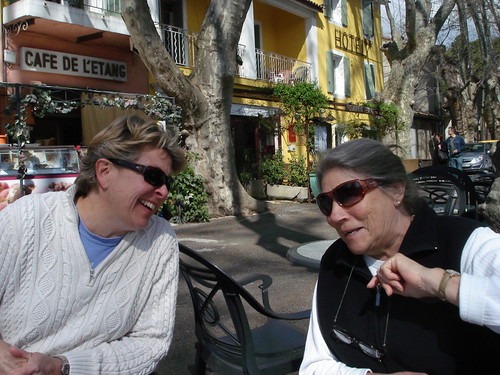
Saturday, April 17, 2010
Sometimes the best food comes from the street
We've been in Ansouis, in Provence, south of France since April 1, and today's April 17. So I guess we've been here a little bit, and are getting settled in. We're here for five weeks total, so it's close to the halfway point. Susan's been good about timely blogging. Check out If It's Tuesday, this Must be Ansouis.
 It does seem like a lot of our time is spent thinking about food. We're doing most of our own cooking, save for a few lunches while we're out. We've opted not to have a car, at least for awhile, which means that we need to pay attention to where and when "market day" is in the towns we can reach by bike or bus.
Sunday mornings, our little village has a small market. Really small. The first Sunday there was the Chicken Guy, a produce vendor, and a purveyor of salamis. The next week saw one garment and one jewelry vendor. We'd seen the Chicken Guy and his competitors at the various markets. They have chickens cooking on rotisseries, with potatoes cooking in the fat just below. I promise to take a picture next time, but the picture doesn't convey the scent. The chicken guy does more than chicken. He also has ribs, ham, and rabbits.
We decided on Saturday, planning ahead to Sunday, that we'd get a rabbit with some potatoes. I dreamt about the potatoes. (Have I told you about the potatoes around here? Light, smooth-skinned, waxy on the inside. A little yellow in the flesh. Kind of like Yukon Gold, but much creamier in texture and sweeter in flavor. I'm told they're local. Susan, who doesn't normally like potatoes, has become a fan.)
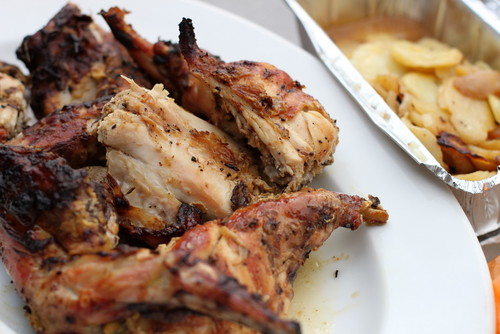
But I digress. The way it works with the rabbits is that you tell the Chicken Man that you want one, he puts it on the spit, and you come back 40 minutes later to claim it. Which we did. Hurrying back, laying it all out, and bustling up the two precarious flights of stairs to the deck. The rabbit was simply prepared, simply cooked, and simply delicious. Perfectly done. Perfectly seasoned. The potatoes were everything I had hoped for and more. I think we added a little salad, but really, it was all about the rabbit.
Then, just yesterday, we ventured to the small city of Pertuis by bus, for the fairly large market there. I'd seen a stall that sold paella the first time we'd been there, and determined to get some to bring home this time. Mussels, clams, shrimp, other unidentified seafood. I bought the version without the rice, but with the amazing saffron-scented broth. Once the seafood was gone, the broth kept on giving as I dipped piece after piece of bread in. And it kept giving a couple of days later when I reheated the broth to go with a simple dinner.
When you do the same thing every day, all day, you can get pretty good at it, as evidenced by the Paella Madam and the Chicken guy.
It does seem like a lot of our time is spent thinking about food. We're doing most of our own cooking, save for a few lunches while we're out. We've opted not to have a car, at least for awhile, which means that we need to pay attention to where and when "market day" is in the towns we can reach by bike or bus. Sunday mornings, our little village has a small market. Really small. The first Sunday there was the Chicken Guy, a produce vendor, and a purveyor of salamis. The next week saw one garment and one jewelry vendor. We'd seen the Chicken Guy and his competitors at the various markets. They have chickens cooking on rotisseries, with potatoes cooking in the fat just below. I promise to take a picture next time, but the picture doesn't convey the scent. The chicken guy does more than chicken. He also has ribs, ham, and rabbits.
We decided on Saturday, planning ahead to Sunday, that we'd get a rabbit with some potatoes. I dreamt about the potatoes. (Have I told you about the potatoes around here? Light, smooth-skinned, waxy on the inside. A little yellow in the flesh. Kind of like Yukon Gold, but much creamier in texture and sweeter in flavor. I'm told they're local. Susan, who doesn't normally like potatoes, has become a fan.)
But I digress. The way it works with the rabbits is that you tell the Chicken Man that you want one, he puts it on the spit, and you come back 40 minutes later to claim it. Which we did. Hurrying back, laying it all out, and bustling up the two precarious flights of stairs to the deck. The rabbit was simply prepared, simply cooked, and simply delicious. Perfectly done. Perfectly seasoned. The potatoes were everything I had hoped for and more. I think we added a little salad, but really, it was all about the rabbit.
Then, just yesterday, we ventured to the small city of Pertuis by bus, for the fairly large market there. I'd seen a stall that sold paella the first time we'd been there, and determined to get some to bring home this time. Mussels, clams, shrimp, other unidentified seafood. I bought the version without the rice, but with the amazing saffron-scented broth. Once the seafood was gone, the broth kept on giving as I dipped piece after piece of bread in. And it kept giving a couple of days later when I reheated the broth to go with a simple dinner.
When you do the same thing every day, all day, you can get pretty good at it, as evidenced by the Paella Madam and the Chicken guy.
Monday, April 12, 2010
A little photography
While in Paris, we had the pleasure of being hosted by an old friend of Susan, named Richard. We were grateful for a place to stay, and a place to be around some real people, rather than the hotels we'd gotten used to. And home cooked meals and tour of the Paris food market, too!
Anyway, I got it into my head that it would be fun to do some portraits, and Richard was a willing participant, especially when I told him he could play guitar while we photographed. Fortunately, Richard's Paris apartment had nice big windows that let in soft light -- perfect for portraits. It was a nice break from the street shooting and tourist subjects I'd been shooting.
The hardest part, of course, was editing. A bunch are on the Flickr stream. And my six favorites are in the Tabblo , part of which is shown above. Click the picture.
I haven't done a whole lot of portrait work, and this was fun. So thanks Richard for being a willing subject.

Anyway, I got it into my head that it would be fun to do some portraits, and Richard was a willing participant, especially when I told him he could play guitar while we photographed. Fortunately, Richard's Paris apartment had nice big windows that let in soft light -- perfect for portraits. It was a nice break from the street shooting and tourist subjects I'd been shooting.
The hardest part, of course, was editing. A bunch are on the Flickr stream. And my six favorites are in the Tabblo , part of which is shown above. Click the picture.
I haven't done a whole lot of portrait work, and this was fun. So thanks Richard for being a willing subject.
Thursday, April 8, 2010
Serendipity
Although we started our time here with a car, we decided to try a slower lifestyle without one for awhile. After a few days of taking in the popular tourist destinations around here (watch the Flickr stream for photos) we needed to dump the car in the center of Aix-en-Provence. Armed with a little photocopied map provided by the car rental agent, we sallied forth, confident we could find our way easily. The signage is great around here. Wayfinding from town to town clearly marked at each junction (usually a well-designed roundabout). Aix-en-Provence turned out to be more challenging, though, since there didn't seem to be ANY street signs. I drove and Susan navigated. My role was to shout out "signs coming up!" and Susan tried to figure out where we were by the few clues that correlated the map with what we saw whizzing by. Then, shout out the appropriate instruction, After having done this through Germany, Austria and Hungary, we found that whomever was driving just had to trust the navigator and go with the directions, without, thinking, military style. Mistakes would be made, for sure, but at least we avoided truly irresponsible driving behavior.
Fortunately, there were several roundabouts, the beauty of which is the ability to circle round and round until you figure out where you want to go. The downside of this approach, however, is that it makes the navigator too dizzy to navigate. We'd wandered around, taken a few turns on pure hunches, and finally got to the point where we were sure we were utterly lost. Susan shouted "pull over here...we need to figure out where we are!!!". So, I pulled over onto a little frontage road. Looked up. And there, a half-block ahead of us, was the welcoming red of the Avis sign. If we had waited until we'd seen the sign, we would not have been able to get on the frontage road, would have had to find some way to double back among the cacophony of one-way streets, and would have had another half hour of confusion.
We looked at each other. Burst out laughing. And gave thanks with a long French kiss. Of course. Serendipity has been our companion on this journey, and we enjoy giving thanks.
Serendipity visited in the kitchen last night, as well.
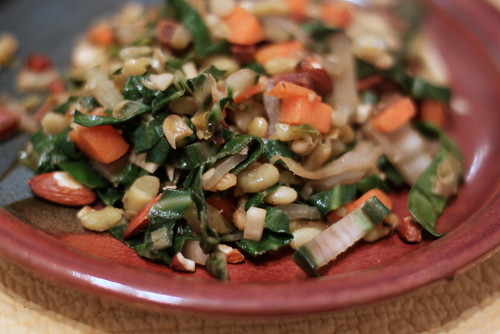
Having eaten at restaurants for the last month, we're now thrilled to have a kitchen. We've been stocking up at the local markets and at the Hyper-U. I found some flageolets -- little greenish/white dried beans that I'd always wanted to try, and now that I was in France, some French beans were in order. We found some unidentified greens (seemed to be softer than bok-choy, but stiffer than swiss chard). And I had seen a recipe for beans and chard on 101 Cookbooks recently for something similar so I thought I'd give it a go. I ventured pretty far afield from Heidi's original, but hers was pretty far afield from her own source.
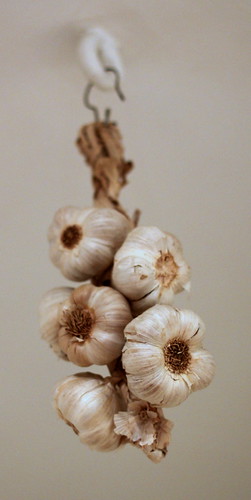 Beans were cooked in the afternoon, and then pan-fried till a little brown. Since the beans were green, and the greens were green, I'd add some color with diced carrots. And a little celery root for flavor. I was going to add garlic, but the garlic here in the rented house had been here all winter, and was only a papery shell, so I was short on flavoring, so i thought I'd add some diced chorizo that we picked up at the market. But this chorizo was mild compared to what I get at home, so it didn't add that much zing. I added a little harissa and some worcestershire sauce at the end, hoping to salvage the effort, but it was still blah.
It was a disappointing meal, and I was glum. The fact that is was nutritious was not much consolation. I don't know where the thought came from, but serendipity was its name. There was a little bottle of vinegar with herbs-de-provence sitting on the counter. What about a splash or two? I'm often astounded by how much flavor a few splashes of vinegar will pack. It was the perfect final touch, bringing all the flavors together and adding the just enough tartness to wake up my mouth.
Serendipity.
Saturday, April 3, 2010
On Language
 At 52 I'm old enough to be allowed a few regrets. One is not having learned languages while I was younger. (The other is not having learned music.)
When growing up, my parents spoke a mixture of English and German to each other and to others of their mostly German-Jewish immigrants and friends. And they particularly spoke German when they didn't want me to understand anything. As a result, I picked up, through osmosis, some basic German, but never really spoke it, and they never really encouraged me to speak.
I went to a Yeshiva for middle school, so I learned Hebrew, and when I got to high school, the choices were Spanish and French (of course), Russian (hey, the Cold War was still on) and Hebrew. Hebrew? Well, the Bronx High School of Science had a lot of Jewish students, and I guess the parents had some pull, so Hebrew was offered. If they had offered German, I would have taken it, but since I already knew some Hebrew, I opted for the easy route, and went with another four years of Hebrew. I can't say I learned a whole lot, but it did me OK when I had a project in Israel about ten years ago. But other than that, not a whole lot of value. I did take a semester of beginning German in college, which was of more value than I ever thought it would be.
We chose to get in and out of central Europe via Frankfurt, since we hadn't quite known what our plan would be, and Frankfurt was, well, central. Most people spoke a little English, but it was fun trying to communicate in German. I was surprised and pleased at how much I could say, and that I could make myself understood in kindergarten sort of way. I'm sure a kindergartner knows more German than I do, but I could ask for directions, figure out a menu (sometimes), joke around a little. I neglected to learn the trick of asking people to speak a little slower, and often used the deer in the headlights face when I had no clue of what someone said to me. But I managed to buy a toll pass at the Austrian/Hungarian border when the toll attendant did not speak English, but did speak "a little" German.
Bits and pieces of things learned 30 and 40 years ago came to the surface so that I could communicate with someone. Best of all was carrying out a conversation with my father's schoolmate (90+ years old) where she spoke no English. We spent about 45 minutes together and between my little German, her vast patience, and lots of hand gestures, we managed to understand each other. Oh, and it turned out she did speak a little French, so Susan and she had a splendid time.
So, with us about to spend about five weeks in Provence, lack of French is frustrating. Fortunately, Susan is fluent and easily charms everyone we meet with her seemingly effortless French sense of humor. While I try to pick up a word or two. I had Susan in stitches tonight at dinner recounting my adventure at the boulangerie (bakery) asking for UN PAIN COMPLETE (one loaf of whole wheat bread), which I pronounced UN PAAA COMPLET, instead of Uuuuuuu paaaaa complaaaaaa, or some such nasal intonation that sounds nothing like the way it looks.
Interestingly, as facile as Susan is with French, she has struggled similarly with German pronunciations, finding everything impossibly guttural. German was much more natural for me, having heard it for years (and that semester of German taught me something!)
I had thought I might try to learn some on our travels, but truly, we did not have enough down time. I'm hoping that our five weeks in one place in Provence provides the opportunity to make the effort. And by my posting it here in my blog, at least some a little incentive to make good on that.
On Tipping
 I've long been frustrated by the idea of tipping. Why should the compensation of waiters, bellhops and others in the service industry be dependent on the goodwill (or not) of their customers? If a waiter provides great service in the hope of getting a good tip, but the customer is in a bad mood, or cheap, or mean, that good service goes unrecognized, and the server is basically screwed. Tipping allows restaurants to pay their employees a pittance, and saddles the employees with the risk of not getting paid. Maintaining good service should be the responsibility of management. If I get bad service, I won't come back to the restaurant. If I get good service, and good food, I will. Ensuring that these happen is management's responsibility.
So it was with great joy that I discovered in Italy that there is no tipping. The price on the menu is the price you pay. Tax and tip included. How simple. Of course, it took me a few days to figure this out, and I was happily leaving little tips (I knew tipping was "less" in Europe). Until we shared a meal with some Norwegians and Dutch, who clearly left no tip.
I continued this behavior through Budapest and Austria. Getting to Germany, I found that there's generally no tipping, except for extraordinary service. And then, it's only a euro or two. And the way you tip is odd. The waiter brings over the bill, and stands there waiting to be paid. Let's say the bill is 48 euros. You would tell them, to their face to make it 50. Or 52. Or whatever. Or simply round up to the nearest euro or 5 euros. And they'd make the change accordingly. I figured this out on the last day after being tutored by our accidental dinner companions from Berlin. Their attitude was you could tip "a little" for very good service, but that if you weren't planning to go back, then you didn't need to tip at all. That seemed a little unfair, so we left a little.
Paris seemed to be a mix. Tax was always included, and sometimes a "service charge" of 10-15 percent was also included (but included in the menu price, and simply called out specifically on the bill). Why you would have a separate "service charge" at a restaurant, where having a waiter serve you is clearly part of the experience is another annoyance. Extra good service warranted a little more. If service was not included, I guess you're supposed to tip about 10 percent, but we didn't run into that situation.
Given the differences from place to place in Europe, I would think the waiters in Paris get forgotten a lot. I'd argue for consistency, and that consistency would be -- the price on the menu is what you pay. Let the restaurant owner pay his staff the right amount to keep them happy, and let them manage their employees so that they provide excellent service.
I'm going to have a hard time coming back to the States where 15-20 percent is expected.
Friday, April 2, 2010
Home runs are hard to predict
We've wandered from town to town. Whatever the differences between places, there are a few constants. We need to figure out where things are. How to get around. What we want to see. How to use the money. What the tipping customs are. Sleep. And eat.
I love finding good food. But it can be daunting. I'm constantly on the lookout for fabulous meals, but the reality is that most of them have been pretty mediocre. (We haven't been to France yet, however!) I've already mentioned the lack of variety in Italy. Germany, Hugary and Austria have had more diversity, but we've consistently tried to find authentic cuisine that's spectacular. Actually, that's been more of my mission than Susan's but she enjoys great food too. TripAdvisor and other web resources can be of some help, but that takes time and effort, and a lot of times we just find ourselves out and about, hungry and tired, and just have to pick.
There have been good meals, to be sure, but nothing in the memorable category. Until last night, in an utterly unexpected place. This part of our journey, the driving part, was to have lasted a week and taken us to Budapest, Vienna, and Prague. Cost and logistics considerations caused us to fly from Venice to Frankfurt (Hahn airport, 100 km west of Frankfurt) and drive to Budapest, working our way back to Frankfurt where we would rail to Paris. With two days in Budapest, and then a day in Vienna, we realized we'd bitten off more than we could chew, so we discarded the Prague piece to spend an extra day in Vienna. Since Vienna-Frankfurt was going to be more than 6 hours, we decided to break it up and stay in a well-preserved city called Regensburg.
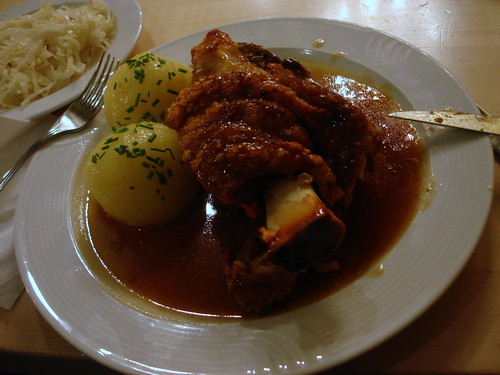
The Hottentotten Inn, an inexpensive, African-themed hotel located in the parking lot of a car repair yard, a bit outside the city walls was run by a crusty older man and his wife who had lived in Africa for seven years. He recommended the Braueri Kneitinger, a Bavarian brewery/eatery that had been in the same family since the 1860s. It was late Saturday afternoon, and stepped into the crowded beer hall where much of the crowd was intent on the fusbol. The host found us a table that we shared with a friendly retired couple from Berlin, who were nice enough to help us interpret the menu. Susan was intent on sausages, this being Bavaria and all. I figured I'd have sausages too, until the Berlin couple mentioned the Schweishaxn, a Bavarian specialty, served with Kartoffelknödel and krautsalat. Schweishaxn is a braised pork shank with skin on, where the skin crisps up. Kartoffelknödel are a mixture of cooked and raw potatoes, formed into a ball a little smaller than a tennis ball. These are served on the plate with a rich brown gravy, which I'd guess is made from the pan drippings and onions. The pork was tender on the inside, crisp on the outside. Salty, but not overwhelmingly so, with a deep savory flavor that was easy to, well, savor. The potato balls were like enormous gnocchi, but not with that starchy texture -- they went down smoothly and were perfect for soaking up the gravy. The cabbage salad was a simple, plain counterpoint. And the house-brewed beer was terrific. We tried two of the heavier ones, the bock (17% alcohol) and the dunkel (12%) were smooth, rich, but not too heavy or overwhelming. They stood up well to the heavier meat.
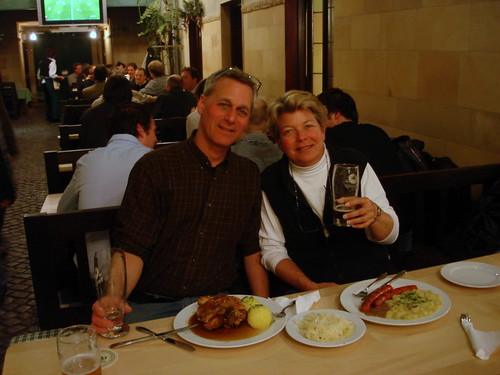 As I was enjoying this meal, I realized that a home run had snuck up on me. The meal was fantastic. Our table companions were friendly and engaging, telling stories of traveling central and northern Europe in their motor home. And we seemed to be among as many Regensburgians as tourists. To top it off, the meal was inexpensive.
I'm writing this on the train from Frankfurt to Paris, where I have high expectations for the food -- hoping for the best!
Subscribe to:
Posts (Atom)

 Posts
Posts